NerveStax · Semantic layer
Every metric, defined once.
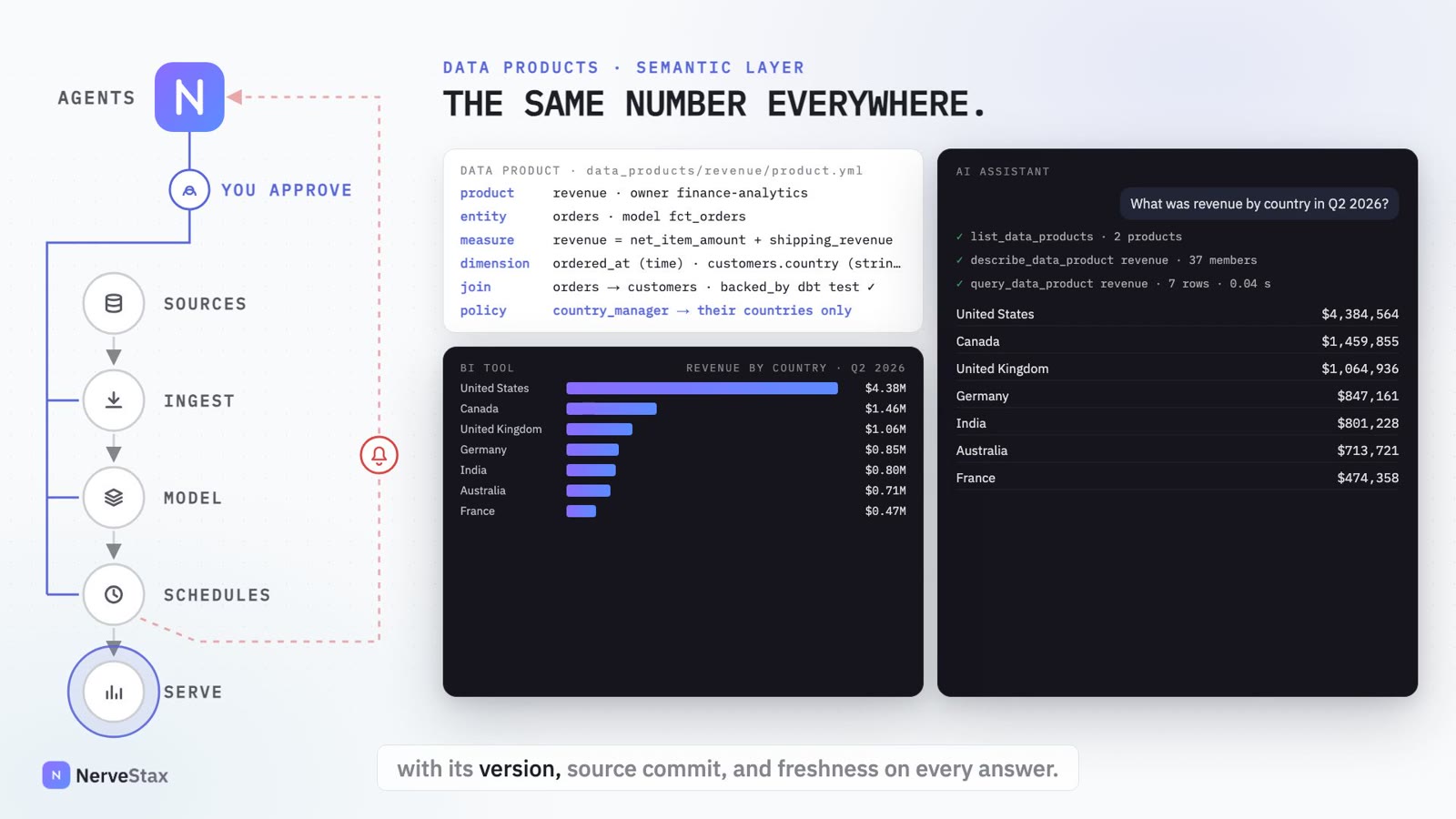
Define each measure once in your dbt repository, as a certified data product. The same definition serves your BI tool, your dashboards and your AI assistants.
 1:24
How it works
Semantic layer, step by step.
Define
Entities, measures, dimensions and joins, in your dbt repository.
Check
Each product is checked against the dbt project and its tests.
Govern
Row and column policies apply at query time.
Serve
One engine serves BI tools, apps and AI assistants.
Watch
Freshness, tests and usage are in view for every product.
One definition
The same number everywhere.
A measure carries its definition, its synonyms and when to use it. Conversational analytics, dashboards, data apps, your BI tool and your AI assistants all read it, with its version and freshness on every answer. A question outside the product is refused with a reason.
Checks
Every join is backed by a test.
A product is checked for unknown members, joins with no dbt test behind them and invalid policies. A product that fails its checks is not served.
- Structured filters and a safe expression grammar. Free-form SQL is not allowed.
- The agent can draft a product from a model’s columns, tests and descriptions, as a pull request.
Policies
Policies, applied at query time.
Row rules filter by group or by the viewer’s own attributes. Measures and dimensions can be hidden from chosen roles. An embedded viewer must have a row rule.
- Policies are shown as plain sentences.
- Each person sees which rules apply to them.
- A policy that names a missing role fails closed.
Quality
Tested after every change, and every night.
A product can carry up to 20 test questions, each with an expected result. A failing case marks the product stale everywhere, with the case named.
In detail
What is in it.
Freshness
Each product’s status comes from the builds and schedules of the models behind it. The worst one wins.
For your BI tool
A PostgreSQL-compatible endpoint, encrypted, using a member’s token.
For AI assistants
Connectors for Claude, ChatGPT and Gemini. Each assistant acts as the member who consented, and never sends raw SQL.
For your apps
A REST API, with a token.
Budgets
Query budgets per member, a shared budget for assistants, a row cap and a timeout.
Deploy-branch guard
Changing a project’s repository or branch retires its served products, so nothing is served from unapproved code.
Warehouses
Verified against DuckDB and MotherDuck, ClickHouse and PostgreSQL.
Audit
Refused queries, budget changes and access changes are always recorded.
Who decides
A person decides. The agent prepares.
The agent has only the permissions of the person it works for, and the approver is recorded.
These wait for a person
- Merging every definition
- Who is in which access group
- Budgets and serving settings
- Turning AI assistant access on (it is off by default)
Transcript of the film
Ask three tools for last quarter’s revenue and you get three numbers. Now your AI assistant gives a fourth.
With NerveStax, a metric is defined once, in your dbt repo, as a data product: a semantic layer people can browse by what things mean.
Every measure carries its definition, its synonyms, and when to use it.
Every join is backed by a dbt test. If the test is missing, the product is refused.
Row and column policies apply at query time. A country manager sees their countries; cost stays with finance.
The same definition serves your BI tool and your AI assistant, with its version, source commit and freshness on every answer. And a question outside the product is refused with a reason.
Assistants connect through one endpoint, with a skill for each product. Never raw SQL.
And the serving engine is yours to watch: what is served, from which warehouse, within which budget.
Data products, defined once. NerveStax.
More of the platform
The other features, each with a film.
See it on your own repository.
Tell us what you run and what is waiting. We will set up a working session on your stack and reply within a working day.